

If you created a personal Google Play developer account recently, you've hit the wall everyone hits: you can't publish your app until you run a closed test with 12 testers for 14 days. Here's exactly what Google requires, how the 14-day clock actually counts, the myths that cost developers weeks, and what can still delay your production access after you've technically met the minimum.
The exact requirement
- 12 testers means 12 users opted in to your closed test.
- When you apply, at least 12 of them must have been continuously opted in for the last 14 days.
- Meeting this makes you eligible to apply — it doesn't guarantee your production access request is approved.
On this page
- What the requirement is
- Why Google introduced it
- How the 14-day timer works
- The timeline, day by day
- What Google sends after the review
- What can delay approval after you've met the minimum
- Myths about the 12-tester rule
- How to get 12 testers for 14 days
- Where developers get stuck
- Want the 14 days handled for you?
- FAQ
What the requirement is
Personal developer accounts created after 13 November 2023 must complete a closed test before they can apply for production access. Google's published bar is opt-in continuity: at least 12 testers, continuously opted in, for at least the last 14 days before you apply. Google separately evaluates tester engagement and feedback as part of the broader review — a related but different bar, and the one that trips up developers who assume the 12/14 minimum is the whole test.
Why Google introduced it
The rule exists to cut low-quality and scam apps from the Play Store. By forcing real pre-launch testing, Google aims to ensure apps are functional and genuinely used before they reach millions of users. It's friction for honest developers, but it's aimed at spammers.
How the 14-day timer works
Google doesn't describe a countdown that starts on a fixed date. The rule is measured backwards from the day you apply: at that moment, at least 12 testers must have been opted in continuously for the preceding 14 days. Everything below follows from that wording.
- It runs per tester, not per test. Each tester's 14 days begin when they opt in. A tester who joins on day 5 of your test isn't one of the 12 until day 19.
- Opting in is what counts, not being added. Putting an email on your tester list or in your Google Group doesn't start anything. The tester has to open the opt-in link and accept, which only works once your closed track is published. See why a tester isn't counting.
- The days must be consecutive. Google's FAQ says the 14 days have to be consecutive. Days from two separate stints don't add up.
- Opting out breaks it. Google's wording: testers who opt in, test for fewer than 14 days and then opt out don't count toward the requirement. A tester who opts back in starts a fresh 14 days.
- One dropout doesn't reset everyone. You only need 12 who meet the bar on the day you apply. If you recruited 15 and one leaves, the other 14 keep their days, which is why a buffer above 12 is worth having.
- Watch the Dashboard, not your invite list. Play Console's Dashboard shows how many testers are opted in. Developers commonly report that figure lagging behind recent opt-ins, so confirm with testers directly if a number looks low.
From our own closed tests, not a Google rule
Pushing new builds to the closed track during the 14 days hasn't reset the count in any test we've run. Google doesn't address updates on its requirements page. Its "more testing required" email does list acting on feedback through updates as a testing best practice, so shipping fixes mid-test helps rather than hurts.
The timeline, day by day
| When | What happens | What you should do |
|---|---|---|
| Day 0 | You create the closed testing track, add testers and send the release for review. The opt-in link works once the track shows Published. | Follow our closed testing setup guide. Recruit a few more than 12. |
| Days 0–2 | Testers open the opt-in link, accept, and install from Google Play. Each tester's 14 days start when they opt in. | Check the Dashboard count against your list and chase anyone who hasn't opted in. |
| Days 1–14 | Testers use the app. This is the engagement and feedback Google asks about later. | Collect specific feedback, fix what breaks, and ship at least one update to the closed track. |
| Day 14+ | Once 12 testers have 14 consecutive opted-in days, you can apply for production access from the Dashboard. | Answer the questionnaire with specifics. Our production access questions and answers covers each one. |
| Review | Google says review usually takes seven days or less, but can occasionally take longer. | Keep the closed test running. If Google asks for more testing, you'll need to continue it. |
| Decision | Google either grants production access or asks for more testing. | If it's more testing, see what "more testing required" means. |
What Google sends after the review
The decision arrives as an email from the Google Play Console team. Both outcomes are below, taken from real closed tests.
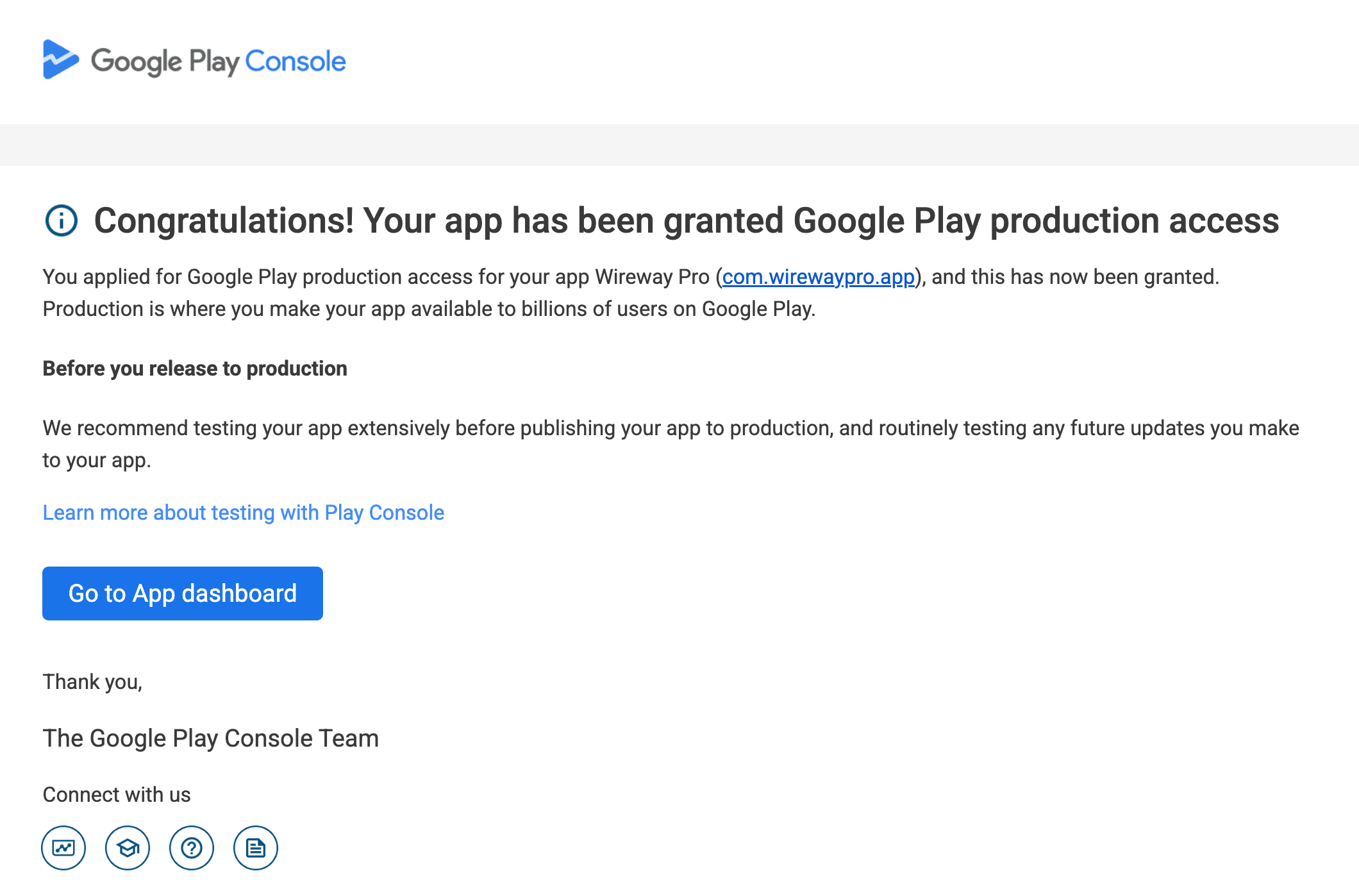
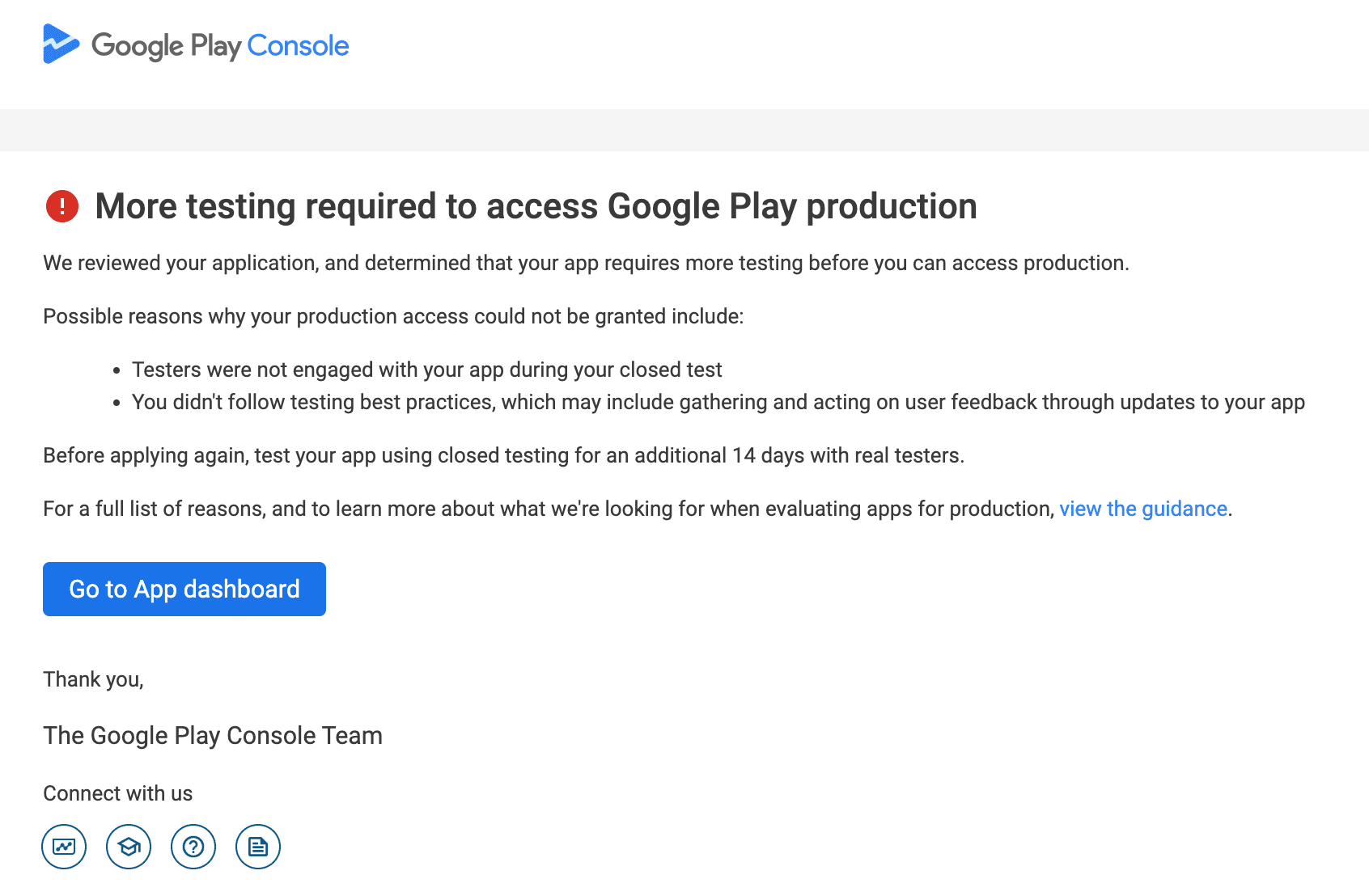
What can delay approval after you've met the minimum
- Weak or inconsistent tester engagement across the 14 days.
- A thin feedback story with nothing specific to point to.
- Vague or generic answers on the production questionnaire.
- An app that still has stability issues.
- Google requesting a further testing round — see our guide on what "more testing required" means.
Myths about the 12-tester rule
- Myth: adding 12 emails is enough. Testers count only once they've opened your opt-in link and accepted. An invite list of 30 can still show 0 opted in.
- Myth: you still need 20 testers. Google required 20 when the rule launched in November 2023 and lowered it to 12 in December 2024. Older tutorials still say 20. See 20 testers vs 12 testers.
- Myth: internal testers count. The requirement is about your closed test. Internal testing is optional, and Google's docs say someone opted in to your internal test isn't eligible for your closed test until they opt out of it. More in internal vs closed testing.
- Myth: the 14 days can be spread out. They have to be consecutive and continuous. Two weeks of testing with a gap in the middle doesn't count.
- Myth: missing one day of app use restarts the clock. Google's published bar is staying opted in, not a daily-open rule. Engagement still matters, but it's judged when Google reviews your application.
- Myth: 12 testers for 14 days means automatic approval. Meeting the minimum makes you eligible to apply. Google still reviews engagement, feedback and app readiness, and can ask for more testing.
- Myth: every developer account has to do this. Google's requirement applies to personal developer accounts created after 13 November 2023. It isn't listed for organization accounts.
How to get 12 testers for 14 days
There are three routes: people you know (friends, family, coworkers, your own users), free tester-exchange groups where developers test each other's apps, and paid managed services. We compare all three, with what each costs and where each fails, in our guide on how to get 12 testers for Google Play.
Where developers get stuck
Finding 12 committed testers is hard, and free tester-swap groups are unreliable — strangers opt in once, then vanish. The production questionnaire also trips people up, because vague answers about engagement and feedback read poorly to reviewers.
This is why many developers use a managed service. Our done-for-you closed testing runs the full 14-day cycle with real, engaged testers and helps you build honest, specific answers for the production questionnaire. If you're weighing whether a service is even allowed, we cover that in our guide on whether hiring testers is against Google Play policy.
Want the 14 days handled for you?
If you'd rather not recruit and chase a cohort yourself, our 12 testers for 14 days service enrolls real Android testers, keeps them engaged across the 14 days, and delivers a written QA report. Google makes the final production-access decision; what we run is the testing.
Frequently asked questions
Do the 14 days have to be continuous?
Yes — Google requires testers to be continuously opted in for at least the last 14 days before you apply. There's no published rule that a single missed day of app usage restarts the count, but consistent engagement across the period is what's evaluated when Google reviews your production access request.
Can I be one of the 12 testers?
You can be one, but you still need at least 12 in total, and they must be genuine testers on real devices with consistent activity.
What happens after Day 14?
You become eligible to apply for production access and complete Google's questionnaire about your testing, tester engagement, and feedback.
Why can production access still be rejected after meeting the minimum?
Because meeting 12 testers for 14 days makes you eligible to apply — it doesn't guarantee approval. Google separately reviews engagement, feedback, and app readiness.
Can a tester be in another country?
Generally yes, though testing-track availability can be controlled by country in Play Console. If a tester reports the app isn't available, check your track's country settings.
What if a tester uninstalls the app?
An uninstall is different from opting out. Keeping a small buffer above the 12-tester minimum is a reasonable precaution so one dropout doesn't put you under the requirement.
How many testers do I need for Google Play?
At least 12, if your personal developer account was created after 13 November 2023. They have to be opted in to a closed test and stay opted in for the 14 days before you apply for production access. The number was 20 until December 2024, which is why older guides still say 20.
When does the 14-day clock start?
Separately for each tester, when they opt in to your closed test. Adding their email doesn't start it. Google measures the requirement backwards from the day you apply, so you need 12 testers who have each been opted in for the 14 days before that day.
Does updating my app reset the 14 days?
Google's requirements page doesn't say that it does, and in our own closed tests new builds haven't reset the count. Google's "more testing required" email lists acting on feedback through updates as a best practice, so updating during the test is encouraged.
Do internal testers count toward the 12?
No. The requirement is about testers opted in to your closed test. Google also says a user opted in to your internal test isn't eligible for your closed test until they opt out of the internal one, so keep the two lists separate. See internal vs closed testing.
What does "0 testers currently opted in" mean?
Play Console hasn't counted anyone as opted in yet. Usually the closed track isn't published, testers haven't opened the opt-in link and accepted, or they used a different Google Account. The Dashboard count can also lag behind recent opt-ins. Our guide on why testers aren't counting walks through each check.
How long does Google take to review production access?
Google says review usually takes seven days or less, but can occasionally take longer. Keep your closed test running while you wait: if Google decides your app needs more testing, you'll need to continue the closed test before reapplying.
Official sources